AI legal research Nigeria
AI Legal Research in Nigeria: Can AI be trusted with Nigerian law?
It depends entirely on where the answer comes from. A general chatbot recalls; a grounded research engine retrieves. Here is how ModulawAI handles Nigerian authority, what it does well, and where you should still open the judgment yourself.
The risk
Why general AI is dangerous on Nigerian authority.
Thin training data
The model has read far more American law than Nigerian.
General models are trained on whatever is abundant on the open web, and Nigerian law reports are not. Ask one about a Nigerian principle and it will answer fluently, frequently by reasoning from English or American analogues, and occasionally by inventing a case name that sounds exactly right. Fluency is not knowledge.
The fix
Retrieve the Nigerian source, then answer from it.
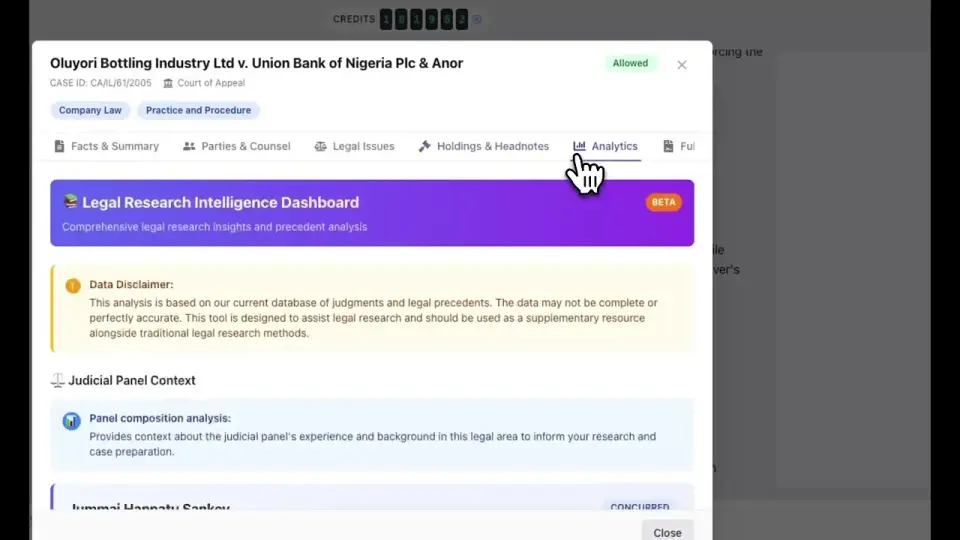
ModulawAI does not ask the model what it remembers. It searches an indexed corpus of Nigerian judgments and legislation, passes the retrieved passages to the model, and requires the answer to be built from them. A case that is not in the corpus cannot be retrieved, and therefore cannot be cited. See the full Nigerian research corpus.
Your part
Read the authority before you rely on it.
We are deliberate about this: the tool is built to make verification fast, not to remove it. Every citation opens. Treat the output the way you would treat a well-prepared junior’s memo: a strong starting position that a senior still reads before it goes to court.
Use it for
Where it earns its place.
Finding the line of authority
Ask the question in your own words and get the Supreme Court and Court of Appeal decisions that address it, with the passages that matter.
Reading a long judgment
Summarise the ratio, the facts, and the dissent, then ask follow-up questions against the judgment itself.
Statutory questions
CAMA 2020, ACJA, and federal legislation answered with the section quoted. See CAMA 2020.
First drafts
Processes, opinions, and correspondence drafted in Word from the research you have just done.
FAQ
Questions, addressed.
Can AI do Nigerian legal research?
Yes, if it is grounded. An AI that retrieves Nigerian judgments and legislation and answers from the retrieved text can research Nigerian law reliably enough to be useful. A general chatbot answering from training data cannot, because Nigerian law reports are thinly represented on the open web and the model will fill gaps by analogy to English or American law.
Will it invent Nigerian case citations?
Answers are composed from documents retrieved at query time and every citation links to its source, so a case that does not exist in the corpus cannot be cited. You should still open the authority before relying on it.
Is it better than searching a Nigerian law report database?
It does a different job. A database returns a list of documents; this returns a reasoned answer with the authorities named, which is faster when you know the question but not the case. Most firms use both, and ModulawAI keeps the result attached to the matter and the time billed against the client.
Does it handle Nigerian procedural rules?
Yes. Rules of court and practice directions are part of the corpus alongside case law and statutes.
The record so far
Courts have started pricing this mistake.
The argument that hallucinated authority is a theoretical risk did not survive contact with the courts. Reported examples, all from outside Nigeria, give a sense of where this is heading.
- Counsel in the MyPillow litigation were fined 3,000 US dollars each over briefs containing fictitious, AI-generated citations.
- A lawyer in Oregon was ordered to pay 109,700 US dollars in sanctions and costs after filing AI-generated errors.
- A federal court sanctioned an attorney who submitted fabricated quotations produced by an AI assistant in an emergency habeas matter, where the client’s deportation was at stake.
- Regulators and judges in other common law jurisdictions have issued warnings that costs may follow where AI produces fake citations.
We are not aware of a reported Nigerian decision on this yet, and we are not going to invent one to make a point. The exposure is nevertheless higher in Nigerian practice, not lower, for a structural reason: the thinner a jurisdiction’s presence in a model’s training data, the more the model falls back on reasoning by analogy from the law it has read, which is overwhelmingly American and English. A confident, well-formed citation to a Nigerian authority that does not exist is exactly what that failure mode produces.
Verification in practice
The four checks that take ninety seconds.
Retrieval removes most of the risk, because an authority that is not in the corpus cannot be retrieved and therefore cannot be cited. It does not remove your obligation. Run these before anything leaves the office.
- Open the authority, do not skim the summary. Every citation in an answer links to the judgment it came from. If a citation will carry weight in your submission, read the passage in the report rather than the paraphrase of it.
- Check the proposition is the ratio, not an obiter remark. This is the failure that survives grounding. The case can be real, the quotation accurate, and the proposition still not what the court decided.
- Confirm the authority is still good. Ask whether it has been distinguished, overruled or doubted, and look at what has cited it since. A correct citation to an overruled case is a worse error than a missing one.
- Match the citation to the report series you are filing against. The same decision appears across different series, and the reference in your list of authorities has to be the one the court can find.
Where we would still open the book. Older decisions, unreported rulings from state High Courts, and very recent judgments that have not yet been reported are where any corpus, ours included, is weakest. If your argument turns on a single authority in one of those categories, treat the research as a starting point and confirm it against the report. The tool is built to make that check fast, not to persuade you to skip it.
Test it against a case you know.
The honest way to evaluate legal AI is to ask it something you can already check. Book a demo and bring one.