Workflows & agents
Legal workflow software that dispatches the routine, under your rules.
Legal workflow software for the predictable work: intake, deadlines, document generation, follow-ups. AI agents for the open-ended work. Both run on the same data model, under the same controls, with the same audit trail.
60%
Less time on admin
24/7
Scheduled workflow runs
Audit
Trail on every action
Yours
Rules, your control
Capabilities
What’s inside.
Workflow builder
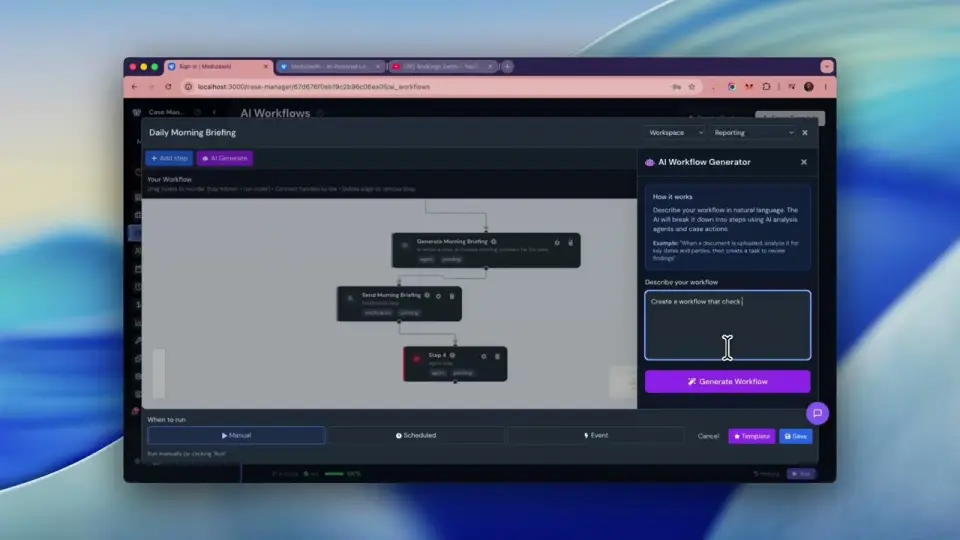
Compose triggers, conditions, and actions visually. Document generation, intake routing, deadline reminders, with no code.
AI agents
AI agents that draft, research, follow up, and progress matters on a schedule, within firm-defined rules and controls.
Triggers
Time-based, event-based, document-based, or matter-status-based. Workflows fire when the right thing happens.
Approvals
Human-in-the-loop where you want it. Critical actions surface for partner review before execution.
Templates
Pre-built workflows for engagement letters, conflict checks, intake triage, hearing reminders, and invoice cadences.
Agent skills
Configure what each agent can and cannot do. Skills are scoped per agent and audited per use.
Versioning and rollback
Every workflow and agent has a version history. Revert a change with one click.
Audit trail
Every workflow run and every agent action is logged with timestamps, inputs, outputs, and the human who reviewed it.
In depth
A closer look.
Two modes
Rules-based when the work is predictable. Agentic when it isn't.
Use workflows for the work you can fully describe: intake triage, deadline reminders, follow-up cadences. Use agents for the work that needs judgement: drafting, research, correspondence. Both share the same data and the same audit infrastructure.
- Workflows: deterministic, fast, ideal for compliance-sensitive tasks
- Agents: contextual, exploratory, ideal for drafting and research
- Switch between modes mid-flow when the work requires it
Control
AI you can actually deploy.
Every agent runs under explicit rules. Every action is logged. Every output is reviewable. Nothing happens that you can't see, reverse, or attribute. That's the difference between AI you can demo and AI you can deploy at a firm.
FAQ
Questions, addressed.
Can AI agents act without review?
Only when you configure them to. Critical actions can require human approval; routine actions can run on a schedule under your rules. You set the threshold per skill.
Is everything an agent does logged?
Yes. Every input, output, decision, and tool call is logged with timestamps. Audit logs are exportable and tamper-evident.
How do workflows differ from agents?
Workflows execute deterministic rules: same input, same output. Agents reason about open-ended work. Both share the same data layer.
Are the workflows hard to build?
No. The builder is visual and most firms start with the bundled templates, then customise. No engineer is required to get value on day one.
The distinction
When to use a workflow and when to use an agent.
These are two different tools that people often confuse, and picking the wrong one is the usual reason automation disappoints. A workflow is for work whose shape you already know. An agent is for work whose shape depends on what it finds.
| Workflow | Agent | |
|---|---|---|
| Behaviour | Deterministic. Same input, same output, every time | Reasons about the task and decides the next step |
| Use it for | File opening, conflict checks, intake, approval routing, closing procedures | Research, document review, drafting, anything needing judgement |
| Predictability | Total. You can read the steps before it runs | Bounded by the rules and approvals you set |
| Who builds it | Anyone, in a visual builder, usually from a bundled template | Described in plain language, refined with a skill |
| Oversight | Gates and required fields | Approval thresholds per action, and a stop control |
Both run on the same data layer, so a workflow can hand off to an agent and an agent can trigger a workflow. Every input, output, decision and tool call is logged with a timestamp, which is the part that matters when somebody asks, months later, why a thing happened.
Keep reading
Related reading.
See it against your matters.
Get started in minutes, or book a demo and we’ll run it on your firm’s real work.