Legal practice management South Africa
Practice management for South African attorneys.
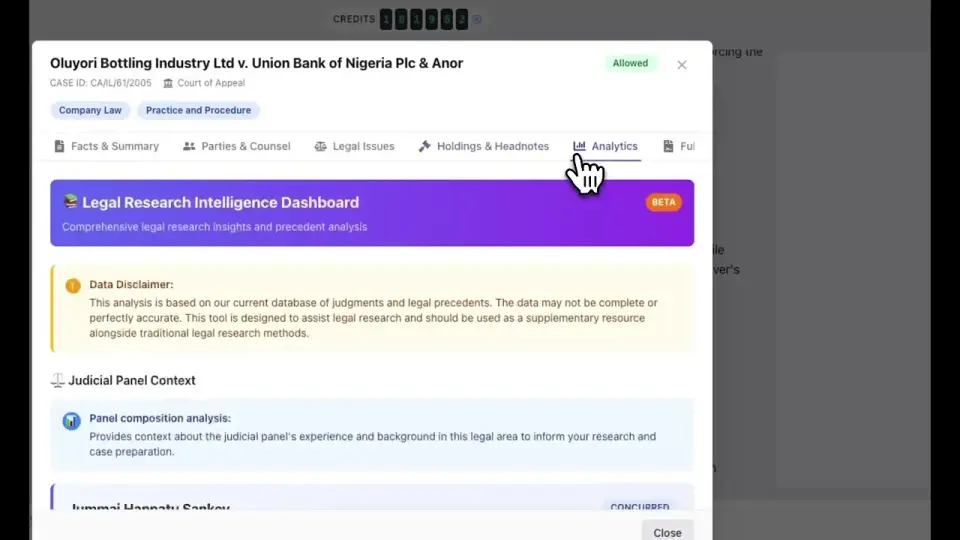
Matters, trust account records, and rand billing, with South African reported judgments and legislation searchable in the same workspace. Built so the file, the money, and the research stop living in three different systems.
ZAR
Billing and invoicing in rand
Trust
Records reconciled continuously
Cited
SA judgments and legislation
8
Jurisdictions for cross-border work
For SA practice
Built for a sophisticated commercial bar.
South Africa has a mature, English-language legal market with high technology adoption and demanding trust accounting obligations. The requirement here is not basic digitisation. It is a system that holds up to scrutiny and does real legal work.
South African research
Reported judgments and legislation searched in plain language, with each authority linked back to its source.
Trust account records
Trust money held and reported separately from business money, reconciled continuously, and exportable for audit.
Data protection
Encrypted, workspace-segregated data with a processing agreement and published subprocessors. See the DPA.
Bulk contract review
One question answered across an entire portfolio, each cell citing the clause it came from.
In depth
Two things SA firms ask first.
Trust
Will it stand up to an audit?
Trust money is segregated from business money, every movement is date-stamped and attributed to a user, and the full ledger exports for review. Obligations under the Legal Practice Act and the rules made under it remain the firm’s responsibility. The platform’s job is to make the evidence complete and easy to produce.
Personal information
Where does client information go?
Client information is encrypted in transit and at rest, segregated per workspace, and never used to train third-party models. A data processing agreement and a published subprocessor list are available, which is the starting point for any POPIA assessment your information officer needs to run. See the data protection policy and subprocessors.
FAQ
Questions, addressed.
What is the best legal practice management software in South Africa?
For a South African firm the test is whether one system can hold matters, trust account records, and rand billing while also doing legal work. ModulawAI covers the practice management ground and adds AI research over South African reported judgments and legislation, drafting inside Microsoft Word, and bulk contract review.
Does it handle trust accounting?
Trust money is held and reported separately from business money and reconciled continuously, with a date-stamped, attributable and exportable ledger. Compliance with the Legal Practice Act and its rules remains the firm’s responsibility.
Is it POPIA compatible?
Client information is encrypted in transit and at rest, segregated per workspace, and never used to train third-party models. A data processing agreement and published subprocessor list support the assessment your information officer carries out. Responsibility for POPIA compliance stays with the firm as responsible party.
Can we bill in rand?
Yes. Invoicing is multi-currency with jurisdiction-aware tax, so rand billing for local clients and other currencies for cross-border work sit on the same matter list.
Does it cover other African jurisdictions?
Yes. Nigerian, Ghanaian, and Kenyan primary law are covered alongside South African, plus US, UK, Canadian, and EU authority. See legal software in Africa.
The compliance year
What the Legal Practice Act puts in the diary.
A South African trust account practice runs on a small number of hard dates, and the Fidelity Fund Certificate depends on having met them. The certificate is not a formality: practising without one is the problem you cannot bill your way out of.
| Obligation | Timing |
|---|---|
| Auditor’s report on the trust account, to the Legal Practice Council | Within six months of the practice’s financial year end |
| First report for a newly established practice | Within six months of commencing practice |
| Report on closure | An audit or inspector’s report within three months of ceasing to practise |
| Fidelity Fund Certificate application | The portal opens on 1 October; practitioners apply by 1 December for the following year |
| Supporting the application | An unqualified trust account audit report, proof of the Legal Practice Management course, and the annual contribution |
Section 86 of the Legal Practice Act 28 of 2014 sets the underlying duty. A trust account practice keeps its trust account at a bank with which the Fidelity Fund has an arrangement, and money held on behalf of another goes in as soon as possible after it is received. The words that cause trouble in practice are “as soon as possible”, because they make receipting a daily discipline rather than a month-end reconciliation exercise.
The chain matters more than any single date. An unqualified audit report depends on clean records through the year; the certificate depends on the report; and the right to practise depends on the certificate. A firm that discovers its record-keeping problem in month five of a six-month window has already lost most of its options.
What the software is for
Make the audit boring.
The aim is not to impress the auditor. It is to hand over a year that reconstructs itself, so the engagement is short and the report comes back unqualified.
- Trust and business money never share a ledger. Every movement carries its date, its matter and the user who made it, and the full ledger exports for the auditor without anyone assembling a spreadsheet.
- Receipting is same-day by design. Money received is captured against the matter when it arrives, which is what “as soon as possible” in s.86 asks of the practice.
- The deadlines are derived from your year end. The six-month audit window and the certificate application period are calendared from the practice’s own financial year, with reminders that escalate rather than lapse.
- The research is in the same workspace. Reported judgments and legislation are searchable where the matter lives, so an opinion cites authority you can open rather than a recollection of it.
- Data handling is documented. Workspace-segregated storage with a processing agreement and a published subprocessor list, which matters for POPIA questions from commercial clients.
What this does not do. It does not audit the trust account, and it does not apply for the Fidelity Fund Certificate. Those remain the practice’s responsibility and the auditor’s work. Compliance with the Legal Practice Act and the rules made under it sits with the firm. What the platform contributes is a complete, attributable record, produced as the work happens rather than assembled afterwards.
See it against your matters.
Book a demo and we will run it on your firm’s real work.